Almost every trust product hands you a single verdict: a score, a level, a green badge. It feels simple. It is also where the money gets lost — because one number has to answer two questions that have nothing to do with each other.
The first question is arithmetic: has this document been altered, and does the signature really belong to the key it claims? Every computer on earth gets the same answer. The second is a judgment call: is the sender someone worth relying on? That answer is different for you than for your competitor, because you deal with different people.
So TrustDID stopped scoring and started reporting. Two questions, answered separately, in words.
Is it genuine?
Pure math. No opinions, no configuration — the same answer for everyone, everywhere.
- YesIntact and correctly signed, and every published record agrees.
- Records disagreeThe signature is valid, but something published contradicts it. Investigate.
- NoThe seal is broken — altered after signing, or not a valid signature.
- UnsignedThere's nothing here to check.
AUTHENTIC · INCONSISTENT · INVALID · UNSIGNEDWho vouches for the sender?
Not math — relationships. Answered against the vouch lists you chose to rely on.
- YesA registry you trust lists this signer, and it can show you the path.
- NoNobody on your lists vouches for them — or one of them revoked them.
- UnknownThe question couldn't be answered, or you never asked it.
TRUSTED · UNLISTED · REVOKED · UNDETERMINED · NOT ASSESSED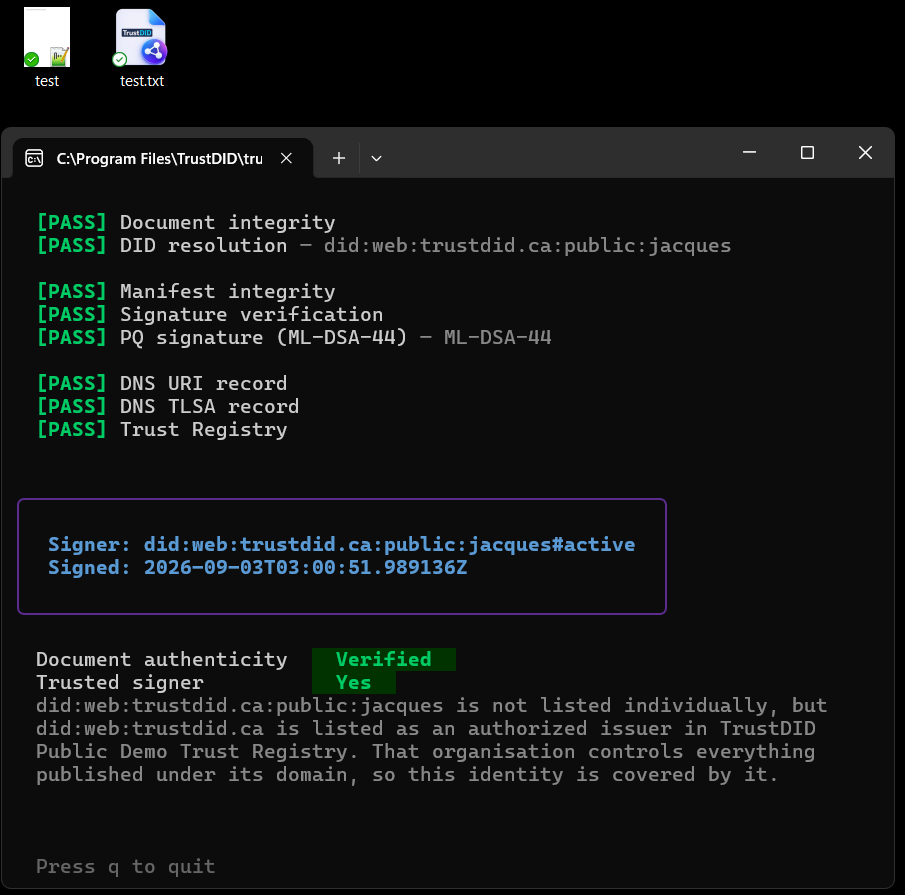
Why two answers catch more
Because the axes are independent, they produce four situations that matter — and a single score blurs exactly the two in the middle.
Proceed
The document is what it claims to be, and someone you trust stands behind the sender. This is the boring case — and it should be most of your day.
The impostor
Flawless paperwork from someone nobody vouches for. A fraudster with their own valid identity lands here — and so does a brand-new supplier. Same signal, so verify the relationship, not the file.
Don't pay it
The seal is broken: this isn't what the sender sent. Who they are stops mattering, so we don't even ask — the answer can't rescue the document.
Investigate
Usually an admin who rotated a key and forgot the DNS. Occasionally the exact shape of a real compromise. Either way it deserves a phone call — which is why it gets its own word instead of hiding inside a lower score.
How firmly is the key tied to the sender?
“Genuine” always travels with a second fact: how many independent channels agree that this key really belongs to this identity. The rungs aren't decoration — each one costs an attacker strictly more.
They said so
The key is published by the sender's own website, and nothing contradicts it.
To fake it, an attacker needs: the web server or its TLS certificate.Their DNS agrees
Records published in the domain's DNS independently name the same key — a completely separate system, run by different people.
Now they also need: the DNS or the registrar account.The DNS proves itself
Those DNS answers are themselves cryptographically signed, provable all the way up to the root of the internet's naming system.
Now they also need: to defeat a signature chain anchored at the DNS root.A sender resting on one channel isn't suspicious — plenty of legitimate businesses never published a DNS record in their life. They're simply less corroborated, and TrustDID says so plainly instead of pretending the difference doesn't exist.
Rules we hold ourselves to
A verdict is only worth as much as its honesty. Four rules keep ours from flattering anyone — including us.
Silence isn't an accusation.
A record that doesn't exist tells you nothing, and we report nothing. Only a record that exists and disagrees is a finding. Absence is normal; contradiction is news.
“We couldn't check” is never “trusted.”
If a registry is unreachable, the answer is unknown — never a quiet pass. And when we answer from a stored copy because the network was down, the result says so, with its age, because a withdrawal since then wouldn't show.
Nobody vouches for themselves.
A sender can name their own registry — and it earns them exactly nothing. Anyone can stand up a list and put themselves on it. Trust only counts when it traces back to a list you chose.
No anchors means no answer.
If you haven't told us whose word you take, the honest report is “never asked” — not “untrusted.” Nobody deserves a bad mark for a question that was never put to them.
The same model, all the way down
This isn't a marketing simplification of something messier underneath — it's the model itself, patent pending, and the exact words the command-line verifier, the plugins and the API all report. See it for yourself in the live demo, or read the technical specification on the verification internals page.