Almost every trust product hands you a single verdict: a score, a level, a green badge. It feels simple. It is also where the money gets lost — because one number has to answer three questions that have very little to do with each other.
The first two are arithmetic: has this document been altered, and does the signature really belong to the identity it claims? Every computer on earth gets the same answers. The third is a judgment call: is that issuer someone worth relying on? That answer is different for you than for your competitor, because you deal with different people.
So TrustDID stopped scoring and started reporting. Three questions, answered separately, in words.
Is this the document that was signed?
Pure arithmetic, computed from the document itself. The same answer for everyone, everywhere.
- YesNot a byte has changed since the receipt was made.
- NoThe receipt no longer matches — something was altered after signing.
- UnsignedThere's nothing here to check.
Was it issued by the identity it claims?
Also arithmetic — against a key the claimed issuer published at their own domain.
- YesThe signature verifies against that identity's published key.
- Records disagreeThe signature is valid, but something published contradicts it. Investigate.
- NoThe signature does not belong to the identity on the receipt.
And who vouches for that issuer?
Not math — relationships. Answered against the vouch lists you chose to rely on.
- YesA registry you trust lists this signer, and it can show you the path.
- NoNobody on your lists vouches for them — or one of them revoked them.
- UnknownThe question couldn't be answered, or you never asked it.
What the tools print today
All three questions are checked on every verification. The first two are both arithmetic and always agree with each other, so the verifier, the add-ins and the API currently report them as a single verdict beside the trust answer. Splitting the report into three is a change we intend to make; the checks behind it already run.
AUTHENTIC · INCONSISTENT · INVALID · UNSIGNEDTRUSTED · UNLISTED · REVOKED · UNDETERMINED · NOT ASSESSED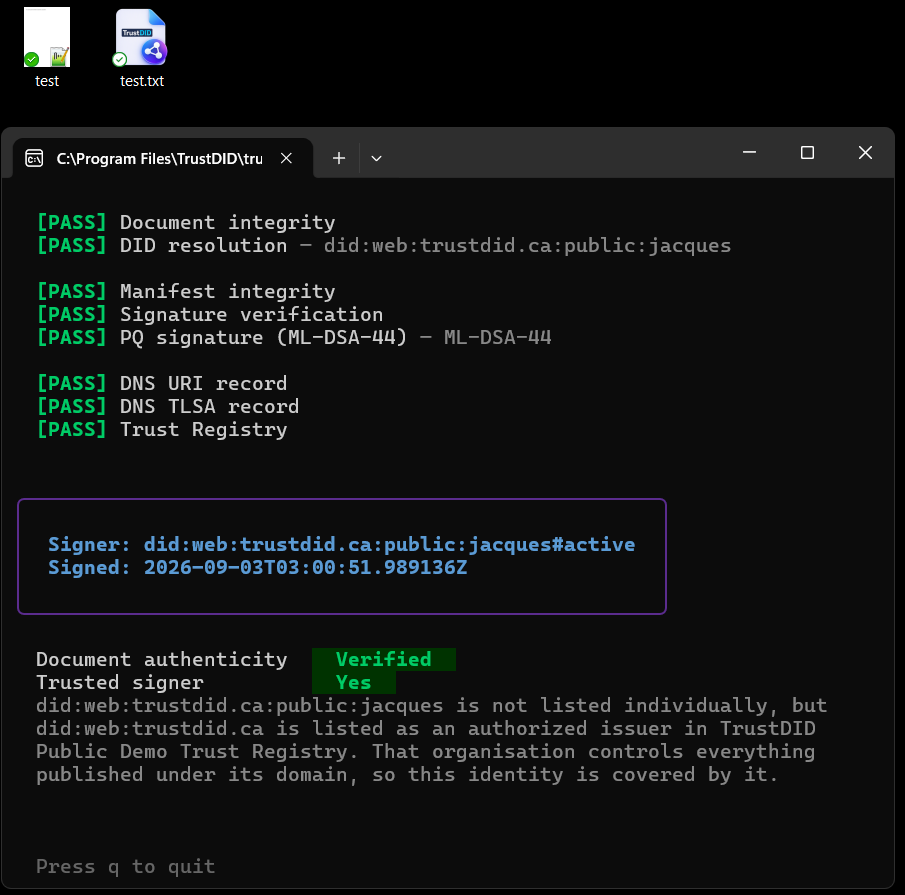
Why separate answers catch more
Arithmetic and judgment are independent of each other, so together they produce four situations that matter — and a single score blurs exactly the two in the middle.
Proceed
The document is what it claims to be, and someone you trust stands behind the sender. This is the boring case — and it should be most of your day.
The impostor
Flawless paperwork from someone nobody vouches for. A fraudster with their own valid identity lands here — and so does a brand-new supplier. Same signal, so verify the relationship, not the file.
Don't pay it
The receipt no longer matches: this isn't what the sender sent. Who they are stops mattering, so we don't even ask — the answer can't rescue the document.
Investigate
Usually an admin who rotated a key and forgot the DNS. Occasionally the exact shape of a real compromise. Either way it deserves a phone call — which is why it gets its own word instead of hiding inside a lower score.
How firmly is the key tied to the issuer?
Provenance is rarely a bare yes. It travels with a second fact: how many independent channels agree that this key really belongs to this identity. The rungs aren't decoration — each one costs an attacker strictly more.
They said so
The key is published by the sender's own website, and nothing contradicts it.
To fake it, an attacker needs: the web server or its TLS certificate.Their DNS agrees
Records published in the domain's DNS independently name the same key — a completely separate system, run by different people.
Now they also need: the DNS or the registrar account.The DNS proves itself
Those DNS answers are themselves cryptographically signed, provable all the way up to the root of the internet's naming system.
Now they also need: to defeat a signature chain anchored at the DNS root.A sender resting on one channel isn't suspicious — plenty of legitimate businesses never published a DNS record in their life. They're simply less corroborated, and TrustDID says so plainly instead of pretending the difference doesn't exist.
Rules we hold ourselves to
A verdict is only worth as much as its honesty. Four rules keep ours from flattering anyone — including us.
Silence isn't an accusation.
A record that doesn't exist tells you nothing, and we report nothing. Only a record that exists and disagrees is a finding. Absence is normal; contradiction is news.
“We couldn't check” is never “trusted.”
If a registry is unreachable, the answer is unknown — never a quiet pass. And when we answer from a stored copy because the network was down, the result says so, with its age, because a withdrawal since then wouldn't show.
Nobody vouches for themselves.
A sender can name their own registry — and it earns them exactly nothing. Anyone can stand up a list and put themselves on it. Trust only counts when it traces back to a list you chose.
No anchors means no answer.
If you haven't told us whose word you take, the honest report is “never asked” — not “untrusted.” Nobody deserves a bad mark for a question that was never put to them.
The same model, all the way down
This isn't a marketing simplification of something messier underneath — it's the model itself, patent pending, and the exact words the command-line verifier, the plugins and the API all report. See it for yourself in the live demo, or read the technical specification on the how a check runs end to end page.